
The 15-Section Doctoral Dissertation Architecture
Topic Selection
Original, feasible, and relevant. Avoid topics that are overly broad or unconstrained in biological/computational scope.
Research Gap & Problem
Formulate 1-sentence gap formula: While [X] is known, [Y] remains uncharacterized, leading to [Z].
Title & Abstract
Title <15 words; 300-word structured abstract: Context → Gap → Methods → Results → Impact.
Introduction
Inverted pyramid: macro global relevance → specific research niche → explicit thesis aims.
Questions & Objectives
Define 1 overarching aim + 3–4 SMART, falsifiable objectives directly mapping to empirical chapters.
Literature Review
Synthesize thematically. Group papers by school of thought, uncover contradictions, and build your case.
Theoretical Framework
Outline the biological paradigms, mathematical axioms, and computational hypotheses guiding the thesis.
Methodology
Forensic reproducibility: software versions, CLI flags, seed numbers, biological replicates, and controls.
Ethics & Data Collection
FAIR data principles, institutional IRB approvals, public SRA/GEO accessions, and sample sheets.
Data Analysis & Results
State strictly what happened. Present publication figures and statistical tests without speculation.
Discussion
Answer why findings matter. Reconcile with conflicting papers, admit limitations, state mechanisms.
Conclusion & Outlook
Answer original research questions, state broader paradigm shift, and outline 3–5 actionable future steps.
References
100% citation consistency using a single format. Audit all active DOIs, PubMed IDs, and retractions.
Appendices
Supplementary tables, full code pipelines, chromatograms, and antibody certifications.
Editing & Viva Prep
Rigorous proofreading, hostile mock defense simulations, and mastering the 2-minute pitch.
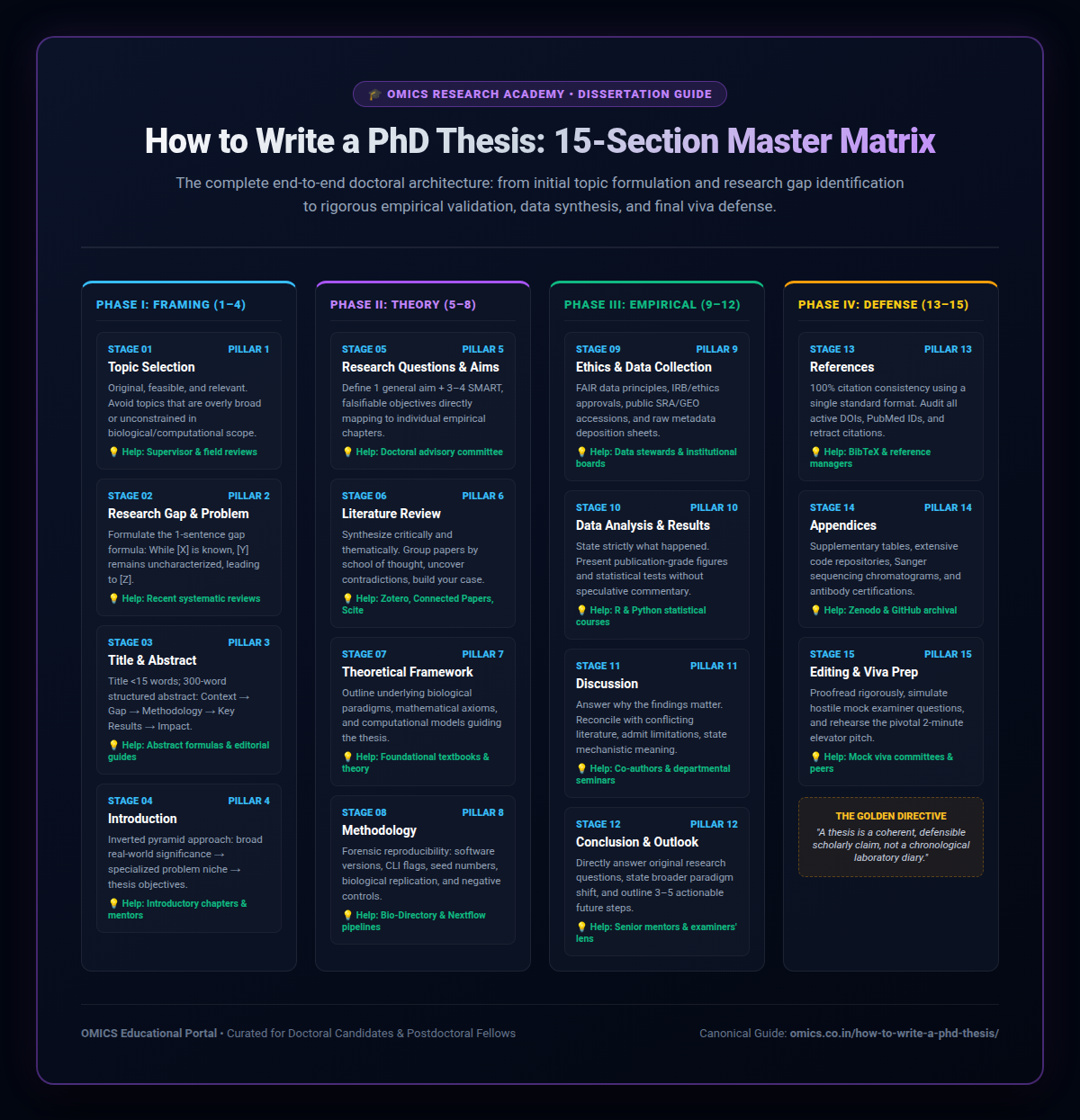
The Golden Rule of Doctoral Writing: A Thesis is an Argument, Not a Diary
The single most common mistake among graduate researchers is treating the thesis as a chronological lab notebook. Examiners do not want to read every failed assay, uncalibrated protocol, or dead-end experiment in historical order. A doctoral dissertation is a coherent, defensible scholarly claim. Every paragraph, table, and statistic exists to support a central hypothesis and demonstrate your mastery of scientific methodology.
Scoping & Framing
Steps 1 – 5: Topic selection, defining the 1-sentence gap, specific title, inverted-pyramid introduction, and measurable objectives.
Rigor & Evidence
Steps 6 – 10: Thematic literature review, conceptual framework, reproducible methodology, ethics protocols, and objective results.
Synthesis & Viva
Steps 11 – 15: Critical discussion, honest limitations, contribution summary, citation integrity, and 2-minute viva elevator pitch.
The Master 15-Section PhD Thesis Guide Table
Below is the comprehensive matrix organizing every section of your thesis, the exact writing directives, key pitfalls to avoid, and the recommended tools and institutional resources:
| Chapter / Section | How to Write & Core Directives | Where to Get Help & Platforms |
|---|---|---|
| 1 Topic Selection |
• Pick an area you truly care about. • Keep it narrow enough to finish in 3 to 4 years. • Get early, structured feedback from your supervisor. | Google Scholar, Scopus, ResearchGate, Dimensions.ai |
| 2 Research Gap & Problem Statement |
• List explicit limitations and contradictions of existing studies. • State the gap in one clear, unambiguous sentence. | Semantic Scholar, Connected Papers, Web of Science, Litmaps |
| 3 Title & Abstract |
• Specific title displaying key variables and organism/context. • 150 to 300 word standalone abstract — written strictly last. | Scribbr, Purdue OWL, Nature Masterclasses |
| 4 Introduction |
• Move from broad societal/scientific background to narrow focus. • Explicitly outline problem, significance, scope, and structural roadmap. | Purdue OWL, UNC Writing Center, Harvard Writing Resources |
| 5 Research Questions & Objectives |
• 2 to 4 focused questions using measurable verbs (quantify, evaluate). • Formulate null/alternative hypotheses only in quantitative hypotheses. | SAGE Research Methods, Scribbr, Research Methods Knowledge Base |
| 6 Literature Review |
• Organize by thematic debates, not author-by-author chronologies. • Compare, contrast, and critique methods; culminate in the research gap. | Google Scholar, JSTOR, Zotero, ResearchRabbit, Elicit |
| 7 Theoretical Framework |
• Choose one or two established theoretical lenses and justify selection. • Provide a conceptual diagram showing how your variables interconnect. | JSTOR, SAGE Research Methods, Stanford Encyclopedia of Philosophy |
| 8 Methodology |
• Describe design, sampling, experimental tools, validity, and reliability. • Provide forensic detail enabling any independent laboratory to replicate. | SAGE Research Methods, Coursera, edX, Nature Protocols, STAR Protocols |
| 9 Ethics & Data Collection |
• Cover informed consent, patient/subject confidentiality, and secure storage. • Describe the raw data collection pipeline step-by-step with dates and controls. | University Ethics Committee (IRB), CITI Program, GDPR/HIPAA compliance |
| 10 Data Analysis & Results |
• Report findings objectively; reserve subjective interpretation for later. • Clear, stand-alone tables and charts explicitly linked to each research question. | R (tidyverse, ggplot2), Python (pandas, scipy), SPSS, NVivo documentation |
| 11 Discussion |
• Explain underlying biological/statistical mechanisms of findings. • Compare with existing literature and be rigorously honest about limitations. | Google Scholar, UNC Writing Center, BMJ Writing Guides |
| 12 Conclusion & Recommendations |
• Summarize primary discoveries and exact contribution to the field. • Propose actionable future research trajectories; introduce zero new data. | Purdue OWL, UNC Writing Center, Thesis Whisperer |
| 13 References |
• Adhere strictly to one citation style (APA, Harvard, IEEE, Nature). • Audit all in-text citations against the reference list; run plagiarism checks. | Zotero, Mendeley, Overleaf BibTeX, APA Style, Crossref |
| 14 Appendices |
• Questionnaires, participant consent forms, large supplementary tables, code. • Ensure every appendix item is referenced at least once in the primary body. | APA Style Guidelines, University Graduate School Formatting Handbook |
| 15 Editing & Viva Prep |
• Rest for 1–2 weeks before proofreading with fresh, critical eyes. • Rehearse your 2-minute elevator pitch summarizing core contribution. | Grammarly, Turnitin, The Thesis Whisperer, Mock Oral Defense Panels |
Tactical Deep-Dive: Mastering the Critical Milestones
1. Formulating the One-Sentence Research Gap (Section 2)
Vague research proposals fail because examiners cannot discern what is already known from what you intend to discover. Use this battle-tested formula to draft your problem statement:
If you cannot articulate your research gap in one sentence, your literature review is not yet finished.
2. The Inverted Pyramid Introduction Structure (Section 4)
Your introduction must guide examiners smoothly from global context to your exact experimental workbench:
- Broad Landscape: The macro challenge (e.g., global crop failure under climate change, metastatic cancer drug resistance).
- Current Paradigms: Established mechanisms and standard technological approaches.
- The Unresolved Frontier: The specific blind spot where current methodologies break down.
- This Thesis's Contribution: Your specific investigation, model system, or algorithm.
- Thesis Roadmap: A brief concluding paragraph outlining what each subsequent chapter covers.
3. The Strict Separation Between Results & Discussion (Sections 10 & 11)
Mixing results and discussion is one of the most frequent reasons examiners require major revisions:
4. Mastering the 2-Minute Viva Opening Pitch (Section 15)
Almost every doctoral defense commences with the lead examiner asking: “In two minutes, can you summarize your thesis and what you consider your primary contribution to knowledge?”
Rehearse this opening until it is second nature:
- 30 seconds: State the problem and why previous literature could not answer it.
- 45 seconds: Explain your novel methodological or analytical approach.
- 30 seconds: State your key definitive discovery with empirical backing.
- 15 seconds: State the exact practical or scientific impact this creates for future research.
Monograph vs. Cumulative Thesis ("Thesis by Publication")
In modern life sciences and computational genomics, many universities permit a Thesis by Publication (or stapler thesis), consisting of 3–5 peer-reviewed first-author papers framed by an overarching general introduction and synthesis discussion. Check your institutional graduate school regulations:
Elevate Your Academic & Computational Research with OMICS Portal
From statistical hypothesis testing in R to next-generation sequencing pipelines and academic interview prep — explore our free open-access training resources.