omics.co.in logo omics.co.in
🧪 TRACK 22 • 10 MODULAR CHAPTERS STRUCTURE-BASED DRUG DESIGN (SBDD) SARS-CoV-2 Mpro • AUTODOCK VINA & PYRX
Biophysical Simulations • Virtual Screening • AlphaFold Target Modeling • Lead Optimization

Molecular Docking & Virtual Screening: Hands-on Training with Real Data

From Biophysical Binding Thermodynamics (ΔG = ΔH - TΔS) to Receptor Preparation, Empirical Scoring, AlphaFold Modeling, CB-Dock2 Cavity Search, PyRx Multi-Threading & SARS-CoV-2 Mpro Hit Selection.

Master the core computational biophysics paradigm powering modern pharmaceutical discovery. This hands-on specialization equips bioinformaticians, medicinal chemists, and life science researchers with protocol-grade expertise across every phase of Structure-Based Virtual Screening (SBVS): resolving crystallographic water policies, calculating physiological protonation states (PROPKA), energy minimizing chemical libraries (MMFF94), defining 3D grid bounding boxes, and validating top poses via PyMOL 3D ray-tracing and BIOVIA Discovery Studio 2D interaction maps.

📦 Production Docking Software & Biophysics Environment Linux / macOS / Windows Conda
# Install Open-Source Docking & Cheminformatics Toolchain via Conda
conda create -n docking_env -c conda-forge vina openbabel rdkit pymol-open-source fpocket -y
conda activate docking_env
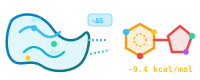
Molecular Docking & Virtual Screening Graphic
Curriculum Specifications Track 22
Format & Duration
Self-Paced / Guided • 10 Modular Chapters
Core Toolchain
PyRx 0.8+ • AutoDock Vina • OpenBabel • RDKit
Case Study Targets
SARS-CoV-2 Mpro (6LU7) • EGFR Kinase
Scoring & Optimization
Lamarckian GA • Grid Box Optimization • -ΔG
Visual & Structural Profiling
PyMOL 3D • Discovery Studio • H-Bond Maps
Academic Access
100% Free & Open Access
View 10 Modules ↓
🧪 View 10 Modules Curriculum ↗
👥

Who Should Attend

🧪
Medicinal Chemists & Drug Hunters Designing small molecules, evaluating binding modes, and prioritizing compound libraries for wet-lab synthesis.
💻
Structural Bioinformaticians Modeling ligand-receptor interactions, predicting binding affinities, and configuring high-throughput Vina screening pipelines.
💊
Pharmacology & Toxicology Scientists Assessing off-target cross-reactivity, ADMET drug-likeness rules, PAINS interference, and hit-to-lead optimization.
🎓
PhD & Master's Researchers Acquiring publication-grade skills in PyRx, AutoDock Vina, AlphaFold2 structure modeling, and PyMOL 3D rendering.
🎯

Learning Outcomes

  • Calculate binding free energy and comprehend thermodynamic drivers (ΔG, ΔH, -TΔS).
  • Resolve crystallographic water molecules, fix missing loops, and assign physiological protonation states with PROPKA.
  • Standardize and energy-minimize ligand libraries (ZINC20, PubChem) using OpenBabel, RDKit, and MMFF94.
  • Discover cryptic and allosteric binding cavities on AlphaFold models via CB-Dock2 curvature and fpocket.
  • Execute high-throughput virtual screening in PyRx 0.8+ and parallel command-line AutoDock Vina.
  • Generate publication-quality 3D PyMOL ray-traced poses and BIOVIA 2D interaction fingerprint diagrams.
🔬 4-PHASE CURRICULUM ARCHITECTURE

Structure-Based Virtual Screening Roadmap & Benchmarks

Self-paced, hands-on masterclass curriculum structured into 4 foundational phases with production command-line scripts and real SARS-CoV-2 Mpro and EGFR kinase drug targets.

PHASE 1

Biophysics & Structure Preparation

Modules 01–03 • Thermodynamics & Target Modeling

  • Thermodynamic binding free energy (ΔG = ΔH - TΔS)
  • Non-covalent forces: H-bonds, salt bridges, pi-stacking
  • Receptor preparation: water policy, loop repair & PROPKA pH 7.4
  • Ligand geometry optimization with OpenBabel MMFF94
  • Search engines: Monte Carlo vs Lamarckian Genetic Algorithm
PHASE 2

Chemical Libraries & AI Structures

Modules 04–06 • ZINC20, PAINS & AlphaFold2

  • Mining RCSB PDB, UniProtKB, PubChem & ZINC20
  • Drug-likeness filters: Lipinski Rule of 5, Veber criteria
  • Filtering false-positive PAINS compounds in RDKit
  • AI structure prediction with AlphaFold2 & ColabFold
  • Validating targets via pLDDT, PAE matrices & Ramachandran
PHASE 3

Cavity Detection & PyRx Screening

Modules 07–08 • CB-Dock2 & AutoDock Vina Workflows

  • Blind docking cavity detection with CB-Dock2 & fpocket
  • Automated grid box sizing around binding pockets
  • Configuring PyRx 0.8+ graphical environment
  • Multi-threaded AutoDock Vina search exhaustiveness
  • Command-line batch scripting for multi-ligand screens
PHASE 4

Ensembles & SARS-CoV-2 Mpro Capstone

Modules 09–10 • Induced Fit, PyMOL & Interaction Maps

  • Flexible side-chain modeling in AutoDock Vina
  • Ensemble docking over Molecular Dynamics (MD) trajectories
  • Capstone: SARS-CoV-2 Mpro virtual screening campaign
  • PyMOL 3D ray-traced binding pocket figures
  • BIOVIA Discovery Studio 2D interaction fingerprint maps
COURSE CURRICULUM

10 Comprehensive Modular Chapters

All modules include step-by-step protocols, CLI scripts, and benchmark PDB datasets
MODULE 01 Phase 1: Biophysics & Prep

Chapter 1: Biophysical Foundations of Molecular Docking: Thermodynamics, Force Fields & SBDD Workflows

Macromolecular recognition principles; free energy of binding (ΔG = ΔH - TΔS); enthalpy-entropy compensation; non-covalent interactions; lock-and-key vs induced fit; role in Structure-Based Drug Design (SBDD); and the complete 8-stage docking simulation pipeline.

🎯 Key Deliverables:
  • Thermodynamic binding energy formulas & SBDD workflow mapping
  • Clean receptor PDBQT with PROPKA pH 7.4 charges & minimized ligands
PDBQT PROPKA OpenBabel MMFF94 Vina LGA
Explore Chapter 01 →
MODULE 02 Phase 1: Biophysics & Prep

Chapter 2: Macromolecular Models & File Formats: Receptor & Small-Molecule Ligand Preparation

PDB, PDBQT, MOL2, SDF, and SMILES format anatomy; receptor preparation, resolving alternate locations, loop repair, crystallographic water policy; protonation states at physiological pH 7.4 via PROPKA; partial charge assignment; and ligand energy minimization with OpenBabel and MGLTools.

🎯 Key Deliverables:
  • Thermodynamic binding energy formulas & SBDD workflow mapping
  • Clean receptor PDBQT with PROPKA pH 7.4 charges & minimized ligands
PDBQT PROPKA OpenBabel MMFF94 Vina LGA
Explore Chapter 02 →
MODULE 03 Phase 1: Biophysics & Prep

Chapter 3: Search Engines & Scoring Functions: Monte Carlo, Genetic Algorithms & Empirical Potentials

Conformational search algorithms: Systematic, Monte Carlo simulated annealing, and Lamarckian Genetic Algorithm (LGA); scoring function classes: physics-based force fields, empirical AutoDock Vina potentials, knowledge-based statistical potentials, and deep learning scoring.

🎯 Key Deliverables:
  • Thermodynamic binding energy formulas & SBDD workflow mapping
  • Clean receptor PDBQT with PROPKA pH 7.4 charges & minimized ligands
PDBQT PROPKA OpenBabel MMFF94 Vina LGA
Explore Chapter 03 →
MODULE 04 Phase 2: Libraries & AI

Chapter 4: Target & Chemical Libraries: RCSB PDB, AlphaFold DB, PubChem, ChEMBL & ZINC20

Macromolecular repositories: RCSB PDB, UniProtKB, AlphaFold DB; chemical small-molecule libraries: PubChem, ChEMBL, and ZINC20 clean lead-like collections; programmatic downloading via REST APIs; library standardization and 3D generation.

🎯 Key Deliverables:
  • Standardized ZINC20 clean lead database with Lipinski filters
  • AlphaFold2 target generation & Ramachandran validation
RCSB PDB ZINC20 RDKit PAINS AlphaFold2
Explore Chapter 04 →
MODULE 05 Phase 2: Libraries & AI

Chapter 5: Virtual Screening Techniques: Drug-Likeness Filters, PAINS & Hit Selection Criteria

Structure-Based Virtual Screening (SBVS) vs Ligand-Based Virtual Screening (LBVS); physicochemical property filters: Lipinski's Rule of 5, Veber's rule; PAINS (Pan-Assay Interference Compounds) elimination; binding affinity thresholds; and ligand efficiency metrics.

🎯 Key Deliverables:
  • Standardized ZINC20 clean lead database with Lipinski filters
  • AlphaFold2 target generation & Ramachandran validation
RCSB PDB ZINC20 RDKit PAINS AlphaFold2
Explore Chapter 05 →
MODULE 06 Phase 2: Libraries & AI

Chapter 6: Structure Prediction from Sequence: SWISS-MODEL Homology & AlphaFold2 / ColabFold

Overcoming crystal structure absences: homology modeling using SWISS-MODEL and MODELLER; AI-driven structure prediction with AlphaFold2 and ColabFold; validating target models via pLDDT confidence scores, PAE error matrices, and Ramachandran plots.

🎯 Key Deliverables:
  • Standardized ZINC20 clean lead database with Lipinski filters
  • AlphaFold2 target generation & Ramachandran validation
RCSB PDB ZINC20 RDKit PAINS AlphaFold2
Explore Chapter 06 →
MODULE 07 Phase 3: Cavity & PyRx

Chapter 7: Blind Docking & Cavity Detection: CB-Dock2, fpocket & Allosteric Pocket Discovery

Targeted vs blind docking paradigms; detecting binding pockets on uncharacterized or orphan proteins; Curvature-Based Docking (CB-Dock2) and fpocket algorithms; automated grid box sizing; and ranking candidate allosteric cavities by Vina affinity score and volume.

🎯 Key Deliverables:
  • CB-Dock2 cavity detection & automated grid box dimensions
  • High-throughput PyRx run & multi-threaded Vina batch scripts
CB-Dock2 fpocket PyRx 0.8 AutoDock Vina Bash CLI
Explore Chapter 07 →
MODULE 08 Phase 3: Cavity & PyRx

Chapter 8: Hands-On Docking Software: PyRx GUI, AutoDock Vina & High-Throughput CLI Workflows

Installing and configuring PyRx 0.8+ with AutoDock Vina and OpenBabel; navigating the PyRx GUI; setting 3D search space grid box coordinates; optimizing search exhaustiveness; running multi-core parallel simulations; and command-line Vina batch automation.

🎯 Key Deliverables:
  • CB-Dock2 cavity detection & automated grid box dimensions
  • High-throughput PyRx run & multi-threaded Vina batch scripts
CB-Dock2 fpocket PyRx 0.8 AutoDock Vina Bash CLI
Explore Chapter 08 →
MODULE 09 Phase 4: Ensembles & Capstone

Chapter 9: Advanced Docking Paradigms: Flexible Receptor Residues, Induced-Fit & MD Ensemble Docking

Beyond rigid-body docking: defining flexible receptor side-chains in AutoDock Vina; Induced-Fit Docking (IFD); ensemble docking across Molecular Dynamics (MD) trajectory clusters; covalent docking for reactive warheads; and cofactor/ion coordination.

🎯 Key Deliverables:
  • Flexible receptor side-chain & MD trajectory ensemble docking
  • SARS-CoV-2 Mpro virtual screen with PyMOL ray-tracing & 2D maps
Flexible Vina MD Ensembles PyMOL 3D BIOVIA DS Quarto
Explore Chapter 09 →
MODULE 10 Phase 4: Ensembles & Capstone

Chapter 10: Capstone Project: SARS-CoV-2 Mpro Virtual Screening, PyMOL 3D & BIOVIA 2D Interaction Reports

End-to-end virtual screening capstone: targeting SARS-CoV-2 Main Protease (6LU7) with a 500-compound natural product & repurposed drug library; 3D binding pose visualization in PyMOL; 2D interaction mapping in BIOVIA Discovery Studio; and Quarto reporting.

🎯 Key Deliverables:
  • Flexible receptor side-chain & MD trajectory ensemble docking
  • SARS-CoV-2 Mpro virtual screen with PyMOL ray-tracing & 2D maps
Flexible Vina MD Ensembles PyMOL 3D BIOVIA DS Quarto
Explore Chapter 10 →
Peer-Reviewed Foundations

📚 Foundational Literature & Methodology Benchmarks

Primary biophysics papers, algorithm benchmarks & scoring citations for Track 22

⚡ Biophysics, Force Fields & AutoDock Vina Foundations

  • Trott O, Olson AJ. (2010). AutoDock Vina: improving the speed and accuracy of docking with a new scoring function, efficient optimization, and multithreading. Journal of Computational Chemistry 31(2):455–461. doi:10.1002/jcc.21334
  • Morris GM, Huey R, Lindstrom W, et al. (2009). AutoDock4 and AutoDockTools4: Automated docking with selective receptor flexibility. Journal of Computational Chemistry 30(16):2785–2791. doi:10.1002/jcc.21256
  • Eberhardt J, Santos-Martins D, Tillack AF, Forli S. (2021). AutoDock Vina 1.2.0: New docking methods, expanded force field, and Python bindings. Journal of Chemical Information and Modeling 61(8):3891–3898. doi:10.1021/acs.jcim.1c00203
  • Dallakyan S, Olson AJ. (2015). Small-molecule library screening by docking with PyRx. Methods in Molecular Biology 1263:243–250. doi:10.1007/978-1-4939-2269-7_19
  • Jin Z, Du X, Xu Y, et al. (2020). Structure of Mpro from SARS-CoV-2 and discovery of its inhibitors. Nature 582:289–293. doi:10.1038/s41586-020-2223-y

🧪 Cheminformatics, Cavities & AI Structure Modeling

  • Jumper J, Evans R, Pritzel A, et al. (2021). Highly accurate protein structure prediction with AlphaFold. Nature 596:583–589. doi:10.1038/s41586-021-03819-2
  • Liu Y, Grimm M, Dai WT, et al. (2020). CB-Dock: a web server for cavity detection-guided protein-ligand blind docking. Bioinformatics 36(6):2014–2015. doi:10.1093/bioinformatics/btz846
  • O'Boyle NM, Banck M, James CA, et al. (2011). Open Babel: An open chemical toolbox. Journal of Cheminformatics 3:33. doi:10.1186/1758-2946-3-33
  • Lipinski CA, Lombardo F, Dominy BW, Feeney PJ. (2001). Experimental and computational approaches to estimate solubility and permeability in drug discovery. Adv Drug Deliv Rev 46(1-3):3–26. doi:10.1016/S0169-409X(00)00129-0
  • Baell JB, Holloway GA. (2010). New substructure filters for removal of pan assay interference compounds (PAINS). Journal of Medicinal Chemistry 53(7):2719–2740. doi:10.1021/jm901137j

Looking for Other Bioinformatics Specializations?

Explore all 20 Flagship Curricula across Structural Biology, Genomics, Transcriptomics, Proteomics, GWAS, and Nextflow Pipelines.

Browse All 20 Curricula (252 Chapters) → Track 04: Structural Bio & AlphaFold → Track 23: WGCNA Network Analysis →