
Bioinformatics & Computational Molecular Biology
15 Hands-On Modules in In Silico Biology, Sequence Retrieval, Gene Editing, Structural Modeling & Molecular Evolution.
Comprehensive practical curriculum for students, faculty, and researchers. Master biological sequence retrieval (NCBI, UniProt, PDB), GC composition & 6-frame translation, ORF finding, thermodynamic PCR primer design, restriction mapping & plasmid cloning, CRISPR-Cas9 guide RNA design, pairwise & multiple sequence alignment (BLAST, Clustal, MUSCLE), molecular phylogenetics, domain architectures (CDD, Pfam), motif discovery (PROSITE), integrative desktop computing with Unipro UGENE, 3D macromolecular structures (PyMOL), AlphaFold 3 structural modeling, and microbial whole-genome sequencing (WGS).
# Core suites mastered across this curriculum:
NCBI BLAST+ • Primer3Plus • Unipro UGENE (Integrated GUI)
PyMOL 3D • AlphaFold 3 / ESMFold • MEGA X (Phylogenetics) • Benchling CRISPR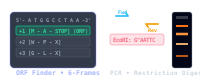
15 Hands-On Curriculum Modules
Click on any module below for production Biopython scripts, tool parameters, mathematical derivations, and hands-on exercises.
Module 01: Biological Databases & Programmatic Sequence Retrieval (NCBI, UniProt, PDB)
Primary vs secondary biological databases, Entrez E-utilities API, UniProtKB curated annotations, PDB atomic coordinates, and automated FASTA sequence extraction with Biopython.
Module 02: Nucleotide Composition, GC Content Analysis & Six-Frame Sequence Translation
GC percentage & isochores, sliding-window GC skew for replication origin detection, CpG island identification, and universal six-frame sequence translation.
Module 03: Open Reading Frame (ORF) Identification & In Silico Gene Prediction
Biological definition of open reading frames, NCBI ORFfinder logic, start/stop codon rules, bacterial vs eukaryotic gene architectures, and coding potential scoring.
Module 04: In Silico PCR Primer Design, Melting Temperature (Tm) & Oligo Quality Control
Thermodynamic nearest-neighbor melting temperatures, GC clamp rules, hairpin loops, primer-dimers, and in silico electronic PCR validation using Primer3 and NCBI Primer-BLAST.
Module 05: In Silico Restriction Mapping & Recombinant Molecular Cloning
Type II restriction endonucleases, palindromic cleavage geometry (sticky vs blunt), isoschizomers, directional plasmid cloning, and simulated agarose gel electrophoresis.
Module 06: In Silico Gene Editing: CRISPR-Cas9 Target Selection & sgRNA Optimization
CRISPR-Cas9 ribonucleoprotein mechanism, Protospacer Adjacent Motif (PAM) scanning, on-target efficiency scoring, off-target cleavage risk mitigation, and donor repair template design.
Module 07: Pairwise Sequence Alignment, Scoring Matrices & Heuristic Database Searching (BLAST)
Global (Needleman-Wunsch) vs local (Smith-Waterman) dynamic programming, PAM vs BLOSUM scoring matrices, Karlin-Altschul E-value statistics, and NCBI BLAST+ command line mastery.
Module 08: Multiple Sequence Alignment (MSA): Algorithms, Gap Penalties & Jalview
Progressive alignment (Clustal Omega), iterative refinement (MUSCLE), fast Fourier transform (MAFFT), affine gap penalties, conservation scoring, and Jalview visual analysis.
Module 09: Molecular Phylogenetics: Tree Construction, Evolutionary Models & Bootstrapping
Distance-based (Neighbor-Joining) vs character-based (Maximum Likelihood) phylogenetic inference, substitution models (JC69, HKY85, GTR), and non-parametric bootstrap validation.
Module 10: Conserved Protein Domain Architecture: CDD, Pfam & InterProScan
Protein domain modularity, NCBI Conserved Domain Database (CDD), Pfam Profile Hidden Markov Models (HMMER), InterPro multi-database signatures, and functional domain mapping.
Module 11: Sequence Motif Discovery & Functional Pattern Matching (PROSITE & MEME)
Deterministic regular expressions in PROSITE, ScanProsite pattern syntax, Position Weight Matrices (PWMs), sequence logos, and de novo motif discovery with the MEME Suite.
Module 12: Integrative Desktop Bioinformatics with Unipro UGENE Workbench
End-to-end desktop life science computing with UGENE: circular plasmid viewer, genome browser tracks, NGS assembly alignment viewer, and automated visual workflow designer.
Module 13: Macromolecular 3D Structure Exploration: PDB, Mol* & PyMOL Visualization
PDB/mmCIF atomic coordinate structures, crystallographic resolution, B-factors, Mol* interactive rendering, PyMOL cartoon/surface representations, and Ramachandran plot validation.
Module 14: Computational Protein Structure Prediction: Homology Modeling to AlphaFold
Comparative homology modeling (SWISS-MODEL), threading, AlphaFold 2/3 and ColabFold deep learning architecture, evoformer representations, and residue confidence metrics (pLDDT & PAE).
Module 15: Whole Genome Sequencing (WGS) Principles & Microbial Genome Analysis
Short-read vs long-read sequencing paradigms, de novo microbial assembly, contig metrics (N50, L50), bacterial structural annotation, and circular genome mapping (BRIG).
📚 Foundational Literature & Methodology Benchmarks
Sequence Alignment & Molecular Tools
- Altschul SF, Gish W, Miller W, Myers EW, Lipman DJ. (1990). Basic local alignment search tool (BLAST). Journal of Molecular Biology 215(3):403–410. doi:10.1016/S0022-2836(05)80360-2
- Edgar RC. (2004). MUSCLE: multiple sequence alignment with high accuracy and high throughput. Nucleic Acids Research 32(5):1792–1797. doi:10.1093/nar/gkh340
- Untergasser A, Cutcutache I, Koressaar T, et al. (2012). Primer3—new capabilities and interfaces. Nucleic Acids Research 40(15):e115. doi:10.1093/nar/gks596
- Okonechnikov K, Golosova O, Fursov M. (2012). Unipro UGENE: a unified bioinformatics toolkit. Bioinformatics 28(8):1166–1167. doi:10.1093/bioinformatics/bts091
Gene Editing & Domain Profiling
- Cong L, Ran FA, Cox D, et al. (2013). Multiplex genome engineering using CRISPR/Cas systems. Science 339(6121):819–823. doi:10.1126/science.1231143
- Hsu PD, Scott DA, Weinstein JA, et al. (2013). DNA targeting specificity of RNA-guided Cas9 nucleases. Nature Biotechnology 31:827–832. doi:10.1038/nbt.2647
- Sigrist CJ, de Castro E, Cerutti L, et al. (2013). New and continuing developments at PROSITE. Nucleic Acids Research 41(D1):D344–D347. doi:10.1093/nar/gks1067
- Lu S, Wang J, Chitsaz F, et al. (2020). CDD/SPARCLE: the conserved domain database in 2020. Nucleic Acids Research 48(D1):D265–D268. doi:10.1093/nar/gkz991
Structural Modeling & Phylogenetics
- Jumper J, Evans R, Pritzel A, et al. (2021). Highly accurate protein structure prediction with AlphaFold. Nature 596:583–589. doi:10.1038/s41586-021-03819-2
- Abramson J, Adler J, Dunger J, et al. (2024). Accurate structure prediction of biomolecular interactions with AlphaFold 3. Nature 630:493–500. doi:10.1038/s41586-024-07487-w
- Berman HM, Westbrook J, Feng Z, et al. (2000). The Protein Data Bank. Nucleic Acids Research 28(1):235–242. doi:10.1093/nar/28.1.235
- Kumar S, Stecher G, Li M, Knyaz C, Tamura K. (2018). MEGA X: Molecular Evolutionary Genetics Analysis across computing platforms. Molecular Biology and Evolution 35(6):1547–1549. doi:10.1093/molbev/msy096