
omics.co.in – Modern Genomics, Bioinformatics Pipelines & Computational Biology Hub
Empowering Modern Genomics, Transcriptomics, Proteomics, Metabolomics, Epigenomics & Bioinformatics Research
High-throughput sequencing architectures, reproducible pipeline blueprints, interactive biological sequence tools, and structured programming curricula for life scientists.
252+
Guides & Chapters
20
Flagship Curricula
16+
Pipelines
100%
Open Access
Click “Map Cut Sites” or type above to scan for cleavage recognition motifs.
Role: Universal Start Codon (Initiation of translation). Hydrophobic sulfur-containing amino acid.
Milestone Research & Discoveries
Recent landmark breakthroughs and peer-reviewed discoveries reshaping high-resolution pangenomics, AI-driven biomolecular interaction modeling, cellular atlases, and climate-resilient agriculture.
Illuminating the Mind: How an Algal Eye Sparked a Revolution in Brain Science
Honouring Karl Deisseroth, Peter Hegemann, and Georg Nagel — “For their discoveries concerning light-gated ion channels and optogenetics.” From photosynthetic green pond scum to restoring human vision and decoding memory engrams, explore how pulses of light unlocked the neural code.
Core Omics & Bioinformatics Disciplines
Explore publication-grade tutorials, computational pipelines, and hands-on courses across foundational and advanced computational biology disciplines.




Research Guides & Special Editorials
Definitive tactical blueprints for doctoral dissertation writing, literature synthesis, and cutting-edge autonomous AI tools for scientific research.
AI Tools for Researchers: The 2025 → 2026 Shift in Scientific Discovery
From surface-level PDF chatbots to autonomous co-scientists: explore the 10 frontlines transforming literature review, figure generation, knowledge mapping, life sciences reasoning, and peer-review defense — featuring AnswerThis, Gatsbi, Ponder, Sourcely, Yomu AI, ResearchCollab, NOAH, Thesify, Rectoly, and ResearchRabbit.
How to Write a PhD Thesis: The Definitive 15-Step Blueprint
Master the complete architectural roadmap for writing a doctoral dissertation in science and bioinformatics: from 3-year topic scoping and defining the 1-sentence gap to reproducible methodology, objective result tables, critical discussion, and 2-minute viva oral defense mastery.
Interactive Pipeline Builder & Tool Recommender
Select your biological assay, sequencing platform, reference organism, and primary analysis goal to instantly generate a vetted, publication-ready computational workflow with runnable bash commands and hardware estimates.
⚙️ Configure Your Experiment
GATK4 / DeepVariant Germline Variant Calling Architecture
Standard production workflow conforming to Broad Institute Best Practices. Raw reads are trimmed, mapped with BWA-MEM2 against GRCh38, marked for duplicates, and processed with GATK4 HaplotypeCaller for high-confidence SNV/InDel discovery.
# Step 1: Quality Control & Trimming
fastp -i input_R1.fq.gz -I input_R2.fq.gz -o clean_R1.fq.gz -O clean_R2.fq.gz --html qc.html

# Step 2: BWA-MEM2 Alignment & Samtools Sort
bwa-mem2 mem -t 16 -R '@RG\tID:sample\tSM:sample\tPL:ILLUMINA' hg38.fa clean_R1.fq.gz clean_R2.fq.gz | \
  samtools sort -@ 8 -o aligned.bam -

# Step 3: Duplicate Marking & Indexing
samtools markdup -@ 8 aligned.bam dedupped.bam && samtools index dedupped.bam

# Step 4: GATK4 HaplotypeCaller Variant Discovery
gatk HaplotypeCaller -R hg38.fa -I dedupped.bam -O raw_variants.vcf.gz
Master Computational Biology Step-by-Step
Whether transitioning from wet-lab genetics or computer science, follow our structured pedagogical pathways to master omics data analysis.

Bioinformatics for Python Developers
Complete guided curriculum from Python programming essentials to algorithmic sequence analysis: Biopython, cancer machine learning, and FASTA/FASTQ manipulation.
Practical NGS & RNA-Seq Data Analysis
End-to-end transcriptomic workflow: raw FASTQ quality control (FastQC/MultiQC), fastp trimming, HISAT2 spliced alignment, featureCounts quantification, DESeq2 differential testing, and STRING networks.
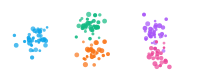
Single-Cell Analysis Starter
Hands-on path from 10x Chromium FASTQs to cell atlas discovery: Cell Ranger alignment, Seurat v5 and Scanpy workflows, doublets removal, Leiden clustering, and marker annotation.
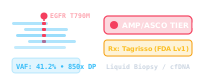
Clinical Genomics & GATK4 Variant Calling
Production germline and somatic variant discovery following Broad Institute Best Practices: BWA-MEM2 alignment, GATK4 HaplotypeCaller, NIST GIAB benchmarking, and Ensembl VEP.
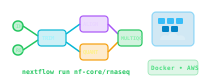
HPC, Linux & Production Pipelines
Master Nextflow DSL2, Snakemake, SLURM batch scheduling, Singularity/Docker containerization, and AWS/GCP cloud batch execution for petabyte-scale genomics.
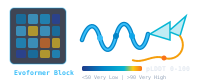
Structural Bio & AI in Biology
Harness neural networks, protein folding foundation models (AlphaFold 3, ESMFold), and molecular dynamics for accelerated biomedical discovery and protein design.
Essential Computational Bio-Tools & Reference Hubs
Interactive calculators, command cheat sheets, lightweight practice datasets, capstone projects, and career preparation designed for the next generation of computational biologists.
Reference Genomes Atlas
Curated reference assemblies across 8 taxonomic branches with latest and legacy download links (FASTA, cDNA, GTF, GFF3, Protein), plus real-time lookup across 100,000+ NCBI species.
Bio-Calculators & Sequence Utilities
Decode SAM alignment flags, estimate NGS coverage depth & flow cell multiplexing, and convert 0-based vs 1-based coordinates.
One-Liner Cookbook & Cheat Sheets
High-yield Awk, Samtools, Bcftools, and Bedtools command one-liners, plus field-by-field specifications for VCF, BAM, and BED formats.
Curated Practice Datasets
Lightweight benchmark datasets (< 15 MB) for rapid testing: 100k paired FASTQs, mini-BAMs, cancer VCFs, and 500-cell single-cell matrices.
Guided Capstone Projects
End-to-end scientific projects: somatic oncology discovery, antibiotic gut microbiome perturbation, and an ideal GitHub portfolio blueprint.
Protocols, QA & FAIR Submissions
Sequencing depth benchmarks across 8 assay types, FastQC troubleshooting diagnostics, batch effect mitigation, and NCBI SRA/GEO submission guides.
Career Hub & 100 Interview Q&As
Top 100 bioinformatics technical interview solutions, industry vs academia career matrices, and a global PhD & postdoc fellowships directory.