
Curriculum Modules
Click on any module below for deep-dive production code, architectural diagrams, bash pipelines, and diagnostic criteria.
1: The Missing Bridge: Connecting Bioinformatics to Clinical Decision Making
Why raw VCF coordinates are clinically silent, the distinction between research discovery and diagnostic pathology, and the 4-phase transformation from raw data to patient care.
2: End-to-End Pipeline Architecture & Workflow Flowchart
Complete unbroken workflow diagram from sequencer FASTQ files through alignment, deduplication, BQSR, variant calling, annotation, and clinical diagnostic reporting.
3: Step 1 — Quality Control (QC) & Preprocessing
FASTQ four-line structure, Phred logarithmic quality score calculations, FastQC metric evaluation, and automated adapter/low-quality base trimming with FastP and Trimmomatic.
4: Step 2 — Read Alignment & Reference Genome Mapping
Human reference builds (GRCh38 vs hs37d5/hg19), Burrows-Wheeler Transform index construction, BWA-MEM read group injection, and STAR 2-pass spliced alignment.
5: Step 3 — Post-Alignment Processing: Deduplication & GATK BQSR
Coordinate sorting, optical vs PCR duplicate marking with GATK MarkDuplicates, and Base Quality Score Recalibration (BQSR) modeling systematic machine error.
6: Step 4 — Variant Calling: Germline vs. Somatic Architecture
Path A: Germline calling with GATK HaplotypeCaller (GVCF), CNNScoreVariants, and DeepVariant vs Path B: Somatic calling with MuTect2, Strelka2, and cross-sample contamination filtering.
7: Step 5 — Functional Annotation Engines & In Silico Predictors
Converting chromosomal coordinates into biological consequences with Ensembl VEP, ANNOVAR, and SnpEff, plus missense impact benchmarking with CADD, REVEL, and AlphaMissense.
8: Step 6 — Clinical & Population Repositories: gnomAD, ClinVar, COSMIC & OMIM
Population allele frequency filtering with gnomAD (BA1/BS1 cutoffs), ClinVar submission evaluation & 4-star hierarchy, somatic hotspots in COSMIC, and OMIM phenotype linkage.
9: Step 7 — The ACMG/AMP 2015 Masterclass: All 28 Criteria Deconstructed
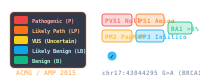
Exhaustive criteria analysis: PVS1 decision tree, PS1-4 strong evidence, PM1-6 moderate evidence, PP1-5 supporting evidence, stand-alone BA1, BS1-4, and BP1-7 benign criteria.
10: ACMG Combining Rules, Bayesian Framework & Clinical Report Generation
Combining rules matrix for 5-tier classification, Tavtigian Bayesian odds-of-pathogenicity formulation, resolving conflicting VUS evidence, and automated clinical PDF reporting.
📚 Foundational Literature & Methodology Benchmarks
ACMG Guidelines & Standards
- Richards S, Aziz N, Bale S, et al. (2015). Standards and guidelines for the interpretation of sequence variants: a joint consensus recommendation of the ACMG and AMP. Genet Med 17(5):405–424. doi:10.1038/gim.2015.30
- Abou Tayoun AN, Pesaran T, DiStefano MT, et al. (2018). Recommendations for interpreting the loss of function PVS1 ACMG/AMP variant criterion. Hum Mutat 39(11):1517–1524. doi:10.1002/humu.23626
- Harrison SM, Biesecker LG, Rehm HL. (2019). Overview of specifications to the ACMG/AMP variant interpretation guidelines. Curr Protoc Hum Genet 103(1):e93. doi:10.1002/cphg.93
Population Databases & Curation
- Chen S, Francioli LC, Goodrich JK, et al. (2024). A genomic mutational constraint map using variation in 76,156 human genomes (gnomAD v4). Nature 625:92–100. doi:10.1038/s41586-023-06045-0
- Landrum MJ, Lee JM, Benson M, et al. (2018). ClinVar: improving access to variant interpretations and supporting evidence. Nucleic Acids Res 46(D1):D1062–D1067. doi:10.1093/nar/gkx1153
- Tavtigian SV, Greenblatt MS, Harrison SM, et al. (2018). Modeling the ACMG/AMP variant classification framework as a Bayesian classification system. Genet Med 20(9):1054–1060. doi:10.1038/gim.2017.210
In Silico Predictors & Splicing
- Jaganathan K, Kyriazopoulou Panagiotopoulou S, et al. (2019). Predicting splicing from primary sequence with deep learning (SpliceAI). Cell 176(3):535–548. doi:10.1016/j.cell.2018.12.015
- Rentzsch P, Witten D, Cooper GM, Shendure J, Kircher M. (2019). CADD: predicting the deleteriousness of variants throughout the human genome. Nucleic Acids Res 47(D1):D886–D894. doi:10.1093/nar/gky1016
- Pejaver V, Urresti J, Lugo-Martinez J, et al. (2020). Inferring the molecular and phenotypic impact of amino acid variants with MutPred2. Nat Commun 11(1):5918. doi:10.1038/s41467-020-19669-x