
Molecular Docking Training Program • Full Syllabus Infographic
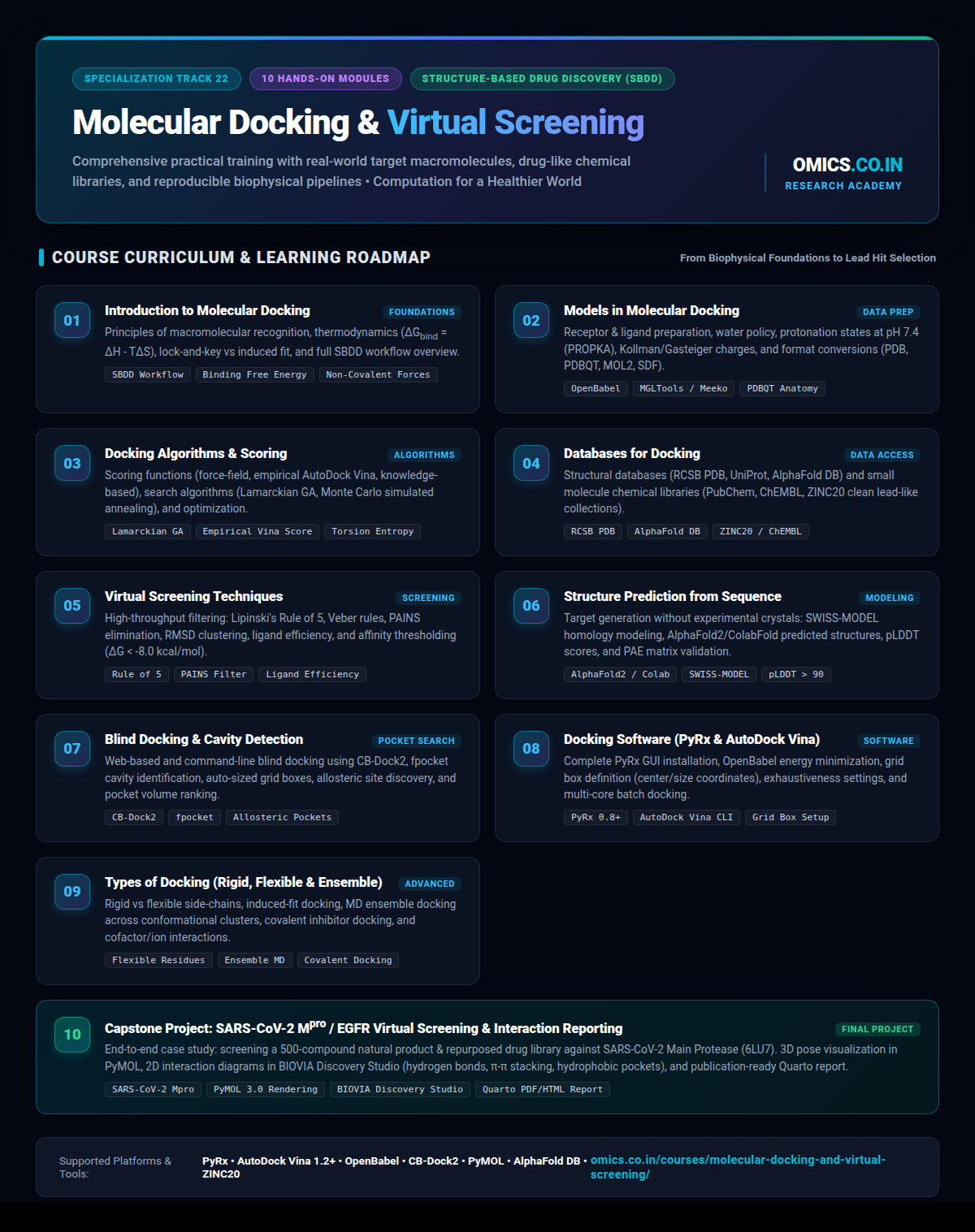
The 10 Modular Training Chapters
Chapter 1: Biophysical Foundations of Molecular Docking: Thermodynamics, Force Fields & SBDD Workflows
Macromolecular recognition principles; free energy of binding (ΔG = ΔH - TΔS); enthalpy-entropy compensation; non-covalent interactions; lock-and-key vs induced fit; role in Structure-Based Drug Design (SBDD); and the complete 8-stage docking simulation pipeline.
Chapter 2: Macromolecular Models & File Formats: Receptor & Small-Molecule Ligand Preparation
PDB, PDBQT, MOL2, SDF, and SMILES format anatomy; receptor preparation, resolving alternate locations, loop repair, crystallographic water policy; protonation states at physiological pH 7.4 via PROPKA; partial charge assignment; and ligand energy minimization with OpenBabel and MGLTools.
Chapter 3: Search Engines & Scoring Functions: Monte Carlo, Genetic Algorithms & Empirical Potentials
Conformational search algorithms: Systematic, Monte Carlo simulated annealing, and Lamarckian Genetic Algorithm (LGA); scoring function classes: physics-based force fields, empirical AutoDock Vina potentials, knowledge-based statistical potentials, and deep learning scoring.
Chapter 4: Target & Chemical Libraries: RCSB PDB, AlphaFold DB, PubChem, ChEMBL & ZINC20
Macromolecular repositories: RCSB PDB, UniProtKB, AlphaFold DB; chemical small-molecule libraries: PubChem, ChEMBL, and ZINC20 clean lead-like collections; programmatic downloading via REST APIs; library standardization and 3D generation.
Chapter 5: Virtual Screening Techniques: Drug-Likeness Filters, PAINS & Hit Selection Criteria
Structure-Based Virtual Screening (SBVS) vs Ligand-Based Virtual Screening (LBVS); physicochemical property filters: Lipinski's Rule of 5, Veber's rule; PAINS (Pan-Assay Interference Compounds) elimination; binding affinity thresholds; and ligand efficiency metrics.
Chapter 6: Structure Prediction from Sequence: SWISS-MODEL Homology & AlphaFold2 / ColabFold
Overcoming crystal structure absences: homology modeling using SWISS-MODEL and MODELLER; AI-driven structure prediction with AlphaFold2 and ColabFold; validating target models via pLDDT confidence scores, PAE error matrices, and Ramachandran plots.
Chapter 7: Blind Docking & Cavity Detection: CB-Dock2, fpocket & Allosteric Pocket Discovery
Targeted vs blind docking paradigms; detecting binding pockets on uncharacterized or orphan proteins; Curvature-Based Docking (CB-Dock2) and fpocket algorithms; automated grid box sizing; and ranking candidate allosteric cavities by Vina affinity score and volume.
Chapter 8: Hands-On Docking Software: PyRx GUI, AutoDock Vina & High-Throughput CLI Workflows
Installing and configuring PyRx 0.8+ with AutoDock Vina and OpenBabel; navigating the PyRx GUI; setting 3D search space grid box coordinates; optimizing search exhaustiveness; running multi-core parallel simulations; and command-line Vina batch automation.
Chapter 9: Advanced Docking Paradigms: Flexible Receptor Residues, Induced-Fit & MD Ensemble Docking
Beyond rigid-body docking: defining flexible receptor side-chains in AutoDock Vina; Induced-Fit Docking (IFD); ensemble docking across Molecular Dynamics (MD) trajectory clusters; covalent docking for reactive warheads; and cofactor/ion coordination.
Chapter 10: Capstone Project: SARS-CoV-2 Mpro Virtual Screening, PyMOL 3D & BIOVIA 2D Interaction Reports
End-to-end virtual screening capstone: targeting SARS-CoV-2 Main Protease (6LU7) with a 500-compound natural product & repurposed drug library; 3D binding pose visualization in PyMOL; 2D interaction mapping in BIOVIA Discovery Studio; and Quarto reporting.
🎯 Target Audience & Prerequisites
- Bioinformatics & Computational Biology: Students and postdocs seeking hands-on competence in structure-based drug discovery.
- Medicinal & Organic Chemists: Wet-lab chemists aiming to prioritize synthetic targets using molecular docking and virtual screening.
- Pharmacology & Biotech Professionals: Industry scientists screening natural product libraries, predicting off-target toxicity, and repurposing drugs.
- Prerequisites: Basic molecular biology understanding. Prior Python or command-line experience is beneficial but not required.
🏆 Key Practical Competencies
- Receptor & Ligand Engineering: PDBQT conversion, protonation state assignment at physiological pH 7.4 (PROPKA), and MMFF94 force field minimization.
- Cavity & Pocket Detection: Blind docking execution with CB-Dock2 and geometric cavity segmentation with fpocket.
- High-Throughput Vina Screening: Multi-threaded CLI batch docking scripts, grid box coordinate sizing, and exhaustiveness tuning.
- Publication Graphics: 3D ray-traced rendering in PyMOL (300 DPI) and 2D non-covalent interaction maps in BIOVIA Discovery Studio.