
The AI Researcher's Toolkit: 2025 → 2026 Shift
Single-PDF Q&A, generic chat assistants, prompt fragility, manual diagram dragging, and isolated software silos.
Multi-hop citation lineages, verified DOI provenance, text-to-vector diagrams, and proactive thesis argumentation audits.
Cross-Paper Consensus
Autonomous multi-paper synthesis over 200M+ research papers with claim-level DOI provenance.
Methodology to Visuals
Generative vector diagrams compiled directly from protocol and methodology text.
Semantic Graph Reasoning
Active semantic hypothesis graphs constructed from multi-modal lab notes and experiments.
Context-Aware Citations
Paragraph-level context matching that uncovers exact empirical evidence for unbacked claims.
Scholarly Prose Copilot
Defensive academic writing copilot avoiding repetitive generic AI fluff and detection flags.
Continuous Systematic Review
Multi-investigator live systematic reviews with dynamic preprint ingestion and consensus scoring.
Target & Pathway Discovery
Autonomous biology reasoning engine connecting omics data, UniProt, and wet-lab protocols.
Hostile Examiner Audit
Structural argument auditing detecting unsubstantiated leaps and thesis vulnerabilities.
Context-Aware Repository
Active workspace indexing datasets, drafts, and citations into an executable research memory.
Multi-Hop Lineage Agents
Recursive multi-hop citation tracing mapping intellectual lineages and scientific disagreements.
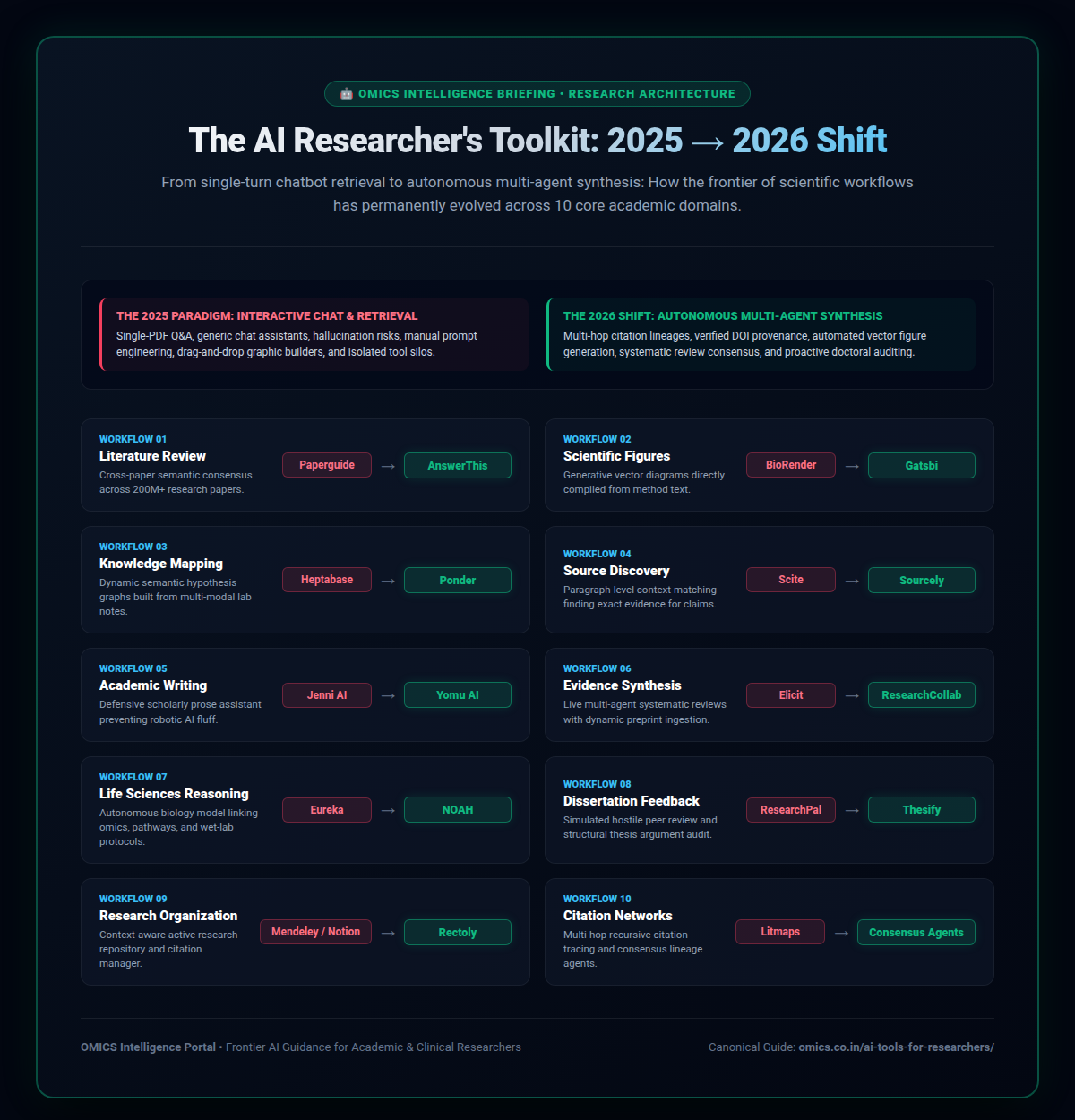
Executive Summary: The Great Shift to Autonomous Research Agents
Between 2023 and 2025, scientific AI was defined by interactive retrieval: chatting with uploaded PDFs, asking chatbots for paper summaries, and drag-and-drop graphic builders. Entering 2026, the academic research landscape has entered the agentic era. The new standard tools do not merely summarize text; they synthesize cross-discipline consensus, trace multi-hop citation genealogies, automate publication-grade illustrations, detect methodological blind spots, and operate as autonomous research collaborators.
The 2025 → 2026 AI Researcher Transition Matrix
To understand why these shifts occurred, consider the fundamental limitations of the 2025 generation and how 2026 architectures resolved them:
| Research Task | 2025 Paradigm | 2026 Shift | The Breakthrough Capability |
|---|---|---|---|
| 1. Literature Review | Paperguide | AnswerThis | Autonomous cross-paper synthesis over 200M+ papers with claim-level DOI provenance. |
| 2. Paper Writing & Figures | BioRender | Gatsbi | AI generative scientific figure composition from methodology text without manual dragging. |
| 3. Knowledge Mapping | Heptabase | Ponder | Active semantic hypothesis graphs automatically derived from disparate lab notes and datasets. |
| 4. Source Discovery | Scite | Sourcely | Paragraph-level context matching that finds supporting evidence for unreferenced claims. |
| 5. Academic Writing | Jenni AI | Yomu AI | Defensive academic writing copilot avoiding generic AI fluff and detection flags. |
| 6. Evidence Synthesis | Elicit | ResearchCollab | Multi-investigator live systematic reviews with dynamic preprint ingestion and consensus scoring. |
| 7. Life Sciences Research | Eureka | NOAH | Autonomous biology reasoning engine connecting omics data, UniProt, and wet-lab protocols. |
| 8. Writing Feedback | ResearchPal | Thesify | Peer-review simulation (Reviewer #2 engine) stress-testing experimental logic and statistical claims. |
| 9. Reference Management | EndNote | Rectoly | Cloud-native, zero-click PDF metadata extraction with instantaneous Overleaf/Word sync. |
| 10. Citation Mapping | Litmaps | ResearchRabbit | Interactive graph networks, co-authorship clustering, and Spotify-style dynamic paper recommendations. |
Deep-Dive: Inside the 10 Frontline Transitions
1. Literature Review: Paperguide → AnswerThis
Multi-Paper SynthesisWhy the change happened: In 2025, tools like Paperguide excel at reading single PDFs. However, researchers rarely need answers from a single isolated paper; they need to synthesize findings across 40 disparate studies to discern scientific consensus.
The 2026 Edge: AnswerThis queries indexed databases of over 200 million papers simultaneously. Rather than just returning snippets, it aggregates contradictory and supporting findings into structured evidence summaries, attributing every sentence to verified DOIs and filtering out retracted papers automatically.
2. Research Paper Writing & Figures: BioRender → Gatsbi
Generative IllustrationWhy the change happened: BioRender democratized scientific clip-art, but researchers still spend 20+ hours manually arranging arrows, membrane channels, and cells on a static canvas.
The 2026 Edge: Gatsbi operates directly on experimental text and protocols. You feed it your "Materials & Methods" or biological pathway hypothesis, and Gatsbi generates contextually accurate vector figures and graphical abstracts adhering to standard journal aesthetic guidelines.
3. Knowledge Mapping: Heptabase → Ponder
Hypothesis GraphsWhy the change happened: Heptabase provided spatial whiteboards for visual learners, but organizing cards remained an entirely manual task prone to cognitive overload.
The 2026 Edge: Ponder is an active cognitive assistant. As you drop papers, laboratory notes, and bioinformatics results onto the board, Ponder builds an evolving knowledge graph, detects unexamined assumptions, and proposes novel testable hypotheses based on graph community structures.
4. Academic Source Discovery: Scite → Sourcely
Context-Aware SourcingWhy the change happened: Scite showed whether citations supported or contrasted a claim. But when drafting a manuscript, researchers need to find which paper proves a specific sentence they just wrote.
The 2026 Edge: Sourcely acts as a reverse search engine. You highlight a passage in your manuscript draft, and Sourcely performs dense semantic embedding searches to find the exact peer-reviewed papers that substantiate that claim, ranking them by journal tier and citation strength.
5. Academic Writing: Jenni AI → Yomu AI
Defensive Academic ProseWhy the change happened: Early autocomplete tools like Jenni AI frequently produced generic, repetitive prose that journal editors and AI detectors flagged instantly.
The 2026 Edge: Yomu AI is tailored specifically for scholarly prose. It preserves the author's nuanced voice, enforces hedging conventions appropriate for scientific discussion ("data suggest" rather than "this proves"), and integrates citation suggestions with zero fabrication.
6. Evidence Synthesis: Elicit → ResearchCollab
Multi-Agent Meta-AnalysisWhy the change happened: Elicit set the standard for tabular data extraction from papers. But systematic literature reviews in fast-moving biomedical fields require real-time team collaboration and live evidence updating.
The 2026 Edge: ResearchCollab enables multi-user living systematic reviews. Teams define extraction schemas, and collaborative agents verify data points across clinical trial registries and bioRxiv preprints, updating consensus tables automatically as new studies appear.
7. Life Sciences Research: Eureka → NOAH
Bio-Reasoning AgentWhy the change happened: Generic AI search engines fail when biological questions require cross-referencing genomic coordinates, UniProt functional domains, and wet-lab assay conditions.
The 2026 Edge: NOAH is a domain-specific life sciences co-scientist. It understands structural biology (AlphaFold pLDDT scores), cellular pathways (KEGG/Reactome), and protocol nuances (lysis buffers, PCR cycling), serving as a true digital lab partner.
8. Academic Writing Feedback: ResearchPal → Thesify
Reviewer #2 SimulatorWhy the change happened: Polishing grammar (Grammarly/ResearchPal) does not help when a paper's fatal flaw is an unaddressed confounding variable or an unsubstantiated statistical inference.
The 2026 Edge: Thesify acts as a simulated journal referee. It interrogates the methodology, identifies missing negative controls, highlights over-extrapolated conclusions, and evaluates alignment with target journal scopes before submission.
9. Reference Management: EndNote → Rectoly
Cloud-Native SyncWhy the change happened: EndNote remains heavy, expensive, desktop-tethered, and plagued by syncing conflicts across operating systems.
The 2026 Edge: Rectoly offers a modern, instantaneous reference manager. It parses dropped PDFs in milliseconds, syncs frictionless BibTeX libraries with Overleaf, and maintains seamless collaborative libraries across research teams.
10. Citation Mapping: Litmaps → ResearchRabbit
Interactive Graph CanvasWhy the change happened: Static citation trees in Litmaps were valuable, but exploring complex interdisciplinary research required dynamic graph pivoting.
The 2026 Edge: ResearchRabbit transforms citation discovery into a fluid, responsive exploration network. Its co-authorship graphs, institutional clustering, and smart email digests alert researchers the moment a key laboratory publishes a relevant preprint.
💡 Building Your 2026 Research Toolkit: Best Practices for Scientists
- Never Outsource Critical Thinking: Use tools like Thesify and AnswerThis to challenge and expand your thinking, not to replace your scientific intuition.
- Verify Every DOI Grounding: Always open the primary source to verify that the extracted numerical finding or $p$-value matches the original text.
- Combine AI with Code: Pair AI literature synthesis with script-based computational biology (R, Python, Bash) so that your analyses remain 100% reproducible.
- Adopt Living Reviews: Move away from one-off static literature surveys toward living, dynamically updated knowledge graphs in tools like ResearchCollab and ResearchRabbit.
Accelerate Your Computational Research with OMICS Portal
Master real-world data analysis in our 20 Flagship Curricula covering Python for Biologists, R Programming, NGS Transcriptomics, Plant Genomics, and Precision Oncology.